
ep. 86. ServiceNow's Real Moat: Context Orchestration for AI
5 min read

Last Thursday was a rough day for software stocks.
The iShares Expanded Tech-Software Sector ETF (IGV) experienced the largest one-day drop (5.4%) since April’s tariff-driven downturn last year. IGV is now down over 13% for the month and, if the pace holds, is headed for its worst monthly result since October 2008 (–23%).
In particular, ServiceNow, a cloud software company that automates enterprise workflows, got significant attention for dropping 10% in a day. This happened even after they posted better-than-expected Q4 results. Zooming out, ServiceNow is down about 43% in a year.

What’s happening with software stocks?
A key driver behind the IGV decline is investors’ mounting concern about AI disruption (it’s fair to say that Anthropic releasing three models in two months fanned the flames). However, ServiceNow’s drop suggests a specific belief can’t be swayed even by strong Q4 results: platforms designed to coordinate human work aren’t valuable in a future with fewer humans in the loop.
“In an environment of heightened investor skepticism on incumbent application vendors, stable growth, in line with expectations, likely falls short of shifting the narrative.” -Morgan Stanley analysts
The Business of Orchestrating Work
ServiceNow built a $10 billion+ business on IT service management. You can think of it as a sophisticated coordination layer between people who need things and people who can provide them within an organization.
Can’t access the shared drive? ServiceNow logs your ticket, categorizes it, routes it to the right technician, ensures it gets resolved on time, and keeps everyone updated.
Need a new laptop? ServiceNow orchestrates the request through procurement, IT, and facilities.
Their revenue models heavily depend on seat licenses. More people in the system means more revenue. The same holds for companies like Atlassian, SAP, and Salesforce. This business model is great if you assume that knowledge work is growing and you will need to orchestrate the tasks that support it. Except, AI is challenging both of those assumptions.
What Can Actually be Automated
At face value, many of the tasks that ServiceNow orchestrates can be automated by AI. They look like routine tasks, characterized by repetitive procedures, clear decision criteria, and well-defined inputs and outputs.
In this automated world, if Bob can’t access the shared drive, Bob submits a request, “the system” checks that Bob has access, the request gets logged, Bob gets access. No need for orchestration because AI just took care of the task.
And, if the San Francisco tech billboards are to be believed, maybe you don’t even need Bob anymore.
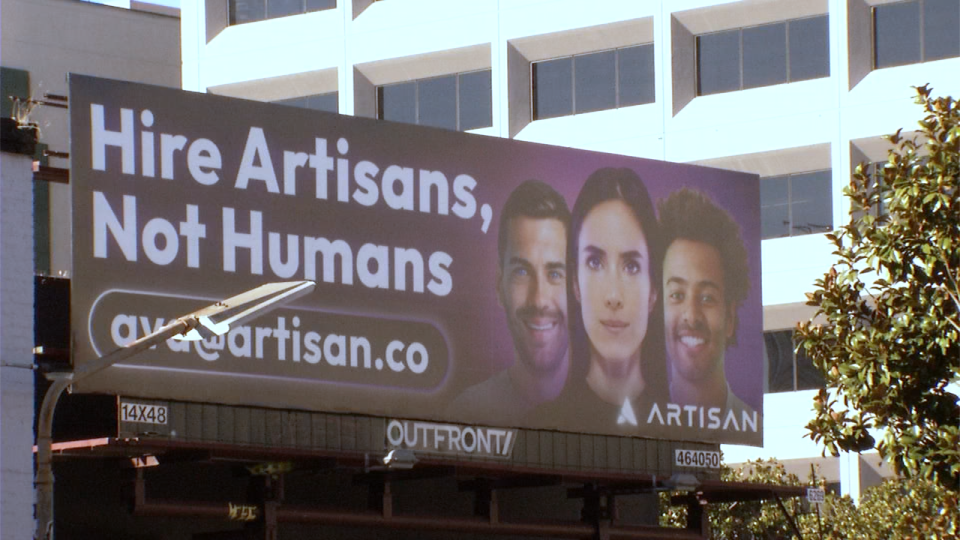
Either way, you have fewer people paying for seats at ServiceNow. AI handles, say, 60% of the routine tasks, leaving only 40% of non-routine tasks that still flow through ServiceNow for human approval or execution.
So far, investor skepticism seems warranted. This future involves significantly fewer seats, and therefore, a fundamental change to ServiceNow’s business model. Pivoting towards something new is a big ask for a company that’s over 20 years old with ~30k employees.
However, investors seem less concerned about ServiceNow being up for the challenge, and more about the company no longer being relevant in an agentic future. The trouble is, they’re underestimating the amount of context AI needs to directly automate underlying tasks well in an enterprise organization.
Much of the context that makes large organizations tick is invisible to AI, such as political dynamics and historical decisions. It lives in people’s heads, the meeting after the meeting, and hallway conversations. Even something as simple as “Reset this person’s password” seems routine until you consider: Is this person leaving the company? Do they still need access? Did they just get promoted and need different permissions? Should you notify their manager?
Part of ServiceNow’s value proposition was (and is) that it creates a context scaffold where none existed. It’s a place for humans to inject context through approvals and oversight. Unless you assume that enterprise-sized organizations go away in an AI-driven, org-flattening future, you still need this orchestration layer.
The Context Orchestration Paradox
When you talk about a partnership between humans and AI, you’re really talking about a system that pairs human and machine strengths. Humans are great at things like context curation, using judgment to determine what inputs an AI system receives. AI agents are great at things like coordinating repetitive actions at scale.
When you tell an agent to do things in an enterprise setting, correct execution often requires input or oversight from multiple human stakeholders. It’s a different challenge than if you’re using an agent to optimize your individual workflow, where you don’t need those extra steps. Compare it to making decisions that require input from two siloed organizations versus on a team of two.
Because organizations are complex systems, you get the context orchestration paradox: more AI autonomy actually increases opportunities for orchestration platforms that successfully capture, structure, and operationalize human context.
Yes, some “very” routine tasks will be automated. Some jobs will go away. ServiceNow will need to adjust to meet the reality of fewer seats and coordinating more complex tasks. Is there a risk that an AI-native company that doesn’t have 20 years of baggage from “the old way of working” figures this out better than ServiceNow? Yes. I won’t argue with that reason to sell your stock.
However, don’t bet against the importance of software as a context-AI orchestration layer in an agentic future. When you have a fleet of stochastic agents working in a complex system, you’ll need a mission control to steer them and system of record to track them.
On their Q4 earnings call, ServiceNow CEO Bill McDermott said: “The real payoff comes when trillions of tokens move beyond pilots to be embedded directly into the workflows where business decisions are made. ServiceNow is the gateway to this shift, serving as the semantic layer that makes AI ubiquitous in the enterprise.”
While he’s biased, I think he’s got it right.
If you liked this episode, you’ll love my book. Designing Automated Futures is coming this year with Rosenfeld Media. 📣 Sign up to be the first to know about new book releases, sales, and events.
🚀 Sendfull in the Wild: C100
On January 23, I had the pleasure of leading a workshop for Canada’s most promising scale-stage tech companies in the C100 Growth Program. I shared tools for structuring, focusing, and reframing customer learning goals as companies scale, drawing from the Sendfull Customer Understanding Toolkit. The opportunities and challenges of building at the forefront of AI and robotics emerged as a key theme throughout conversations with leaders.

I’ll be rejoining C100 on February 27, workshopping with the Fellows Program cohort on how to decide what to offload to AI versus keep human. I’ll be sharing a framework and tools from my upcoming book, Designing Automated Futures.
📣 Call for Proposals: EPIC People Conference
Are you working on questions about modeling context or deploying context? Consider submitting a proposal to the EPIC People Conference, held October 25-27, 2026, in Chicago.
⏰ Deadline: February 23. Learn more here.
I’ve participated in EPIC in various capacities over the years and consistently find it to be a rewarding experience. It’s a rare space where practitioners talk with each other about messy, real-world problems and how to constructively move forward. The conference is worth checking out even if you’re not submitting.
This year, I’m excited to be co-chairing EPIC’s Immersion Day with Todd Palmer. We’re planning an interactive day of learning and making before the main conference. More soon.
⏪ Recent Episodes
ep. 85: Back to School Vibes
ep. 84: The Importance of Anticipation
ep. 83: The Lawn Mower that Ate the Soccer Field
📖 Good Reads
Disempowerment patterns in real-world AI usage (Anthropic): In a new paper on how AI assistants affect human empowerment, research found that offloading belief formation, value-setting, or decision-making to AI can erode autonomy.
WGSN Future Consumer 2026 Report: The leading consumer trends forecaster identified four shopper profiles: the gleamers (burnt out folks looking for a simpler life), the autonomists (consumers rebelling against societal norms), the impartialists (people seeking honest messaging and simplified sales), and the synergists (counterculture and human-tech symbiosis advocates).
China’s Unitree shipped over 5,500 humanoids in 2025: Compare to the ~150 units each shipped per Tesla, Figure AI, and Agility Robotics. Assuming they only sold within their respective countries, China sold more both in absolute terms and per capita.
That’s a wrap 🌯 . More on UX, HCI, and strategy from Sendfull in two weeks.
Something context you want a detox from:
"Much of the context that makes large organizations tick is invisible to AI, such as political dynamics and historical decisions."
This might actually be a good thing. I think that the middle management layer (the "clay"-layer) is facing a lot of pressure for slowing things down. AI is empowering employees who want to get things done