
ep. 37: XR meets exercise
7 min read

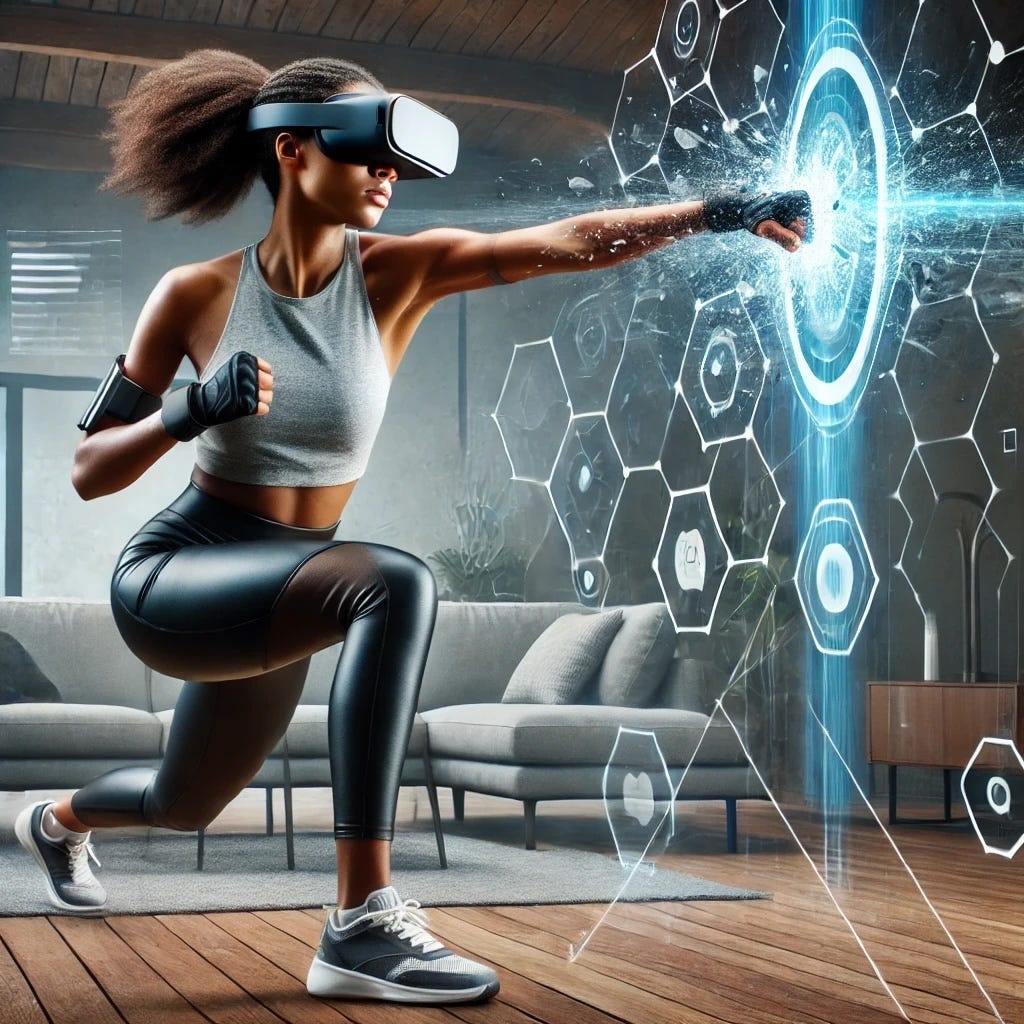
I’m working on a new project that combines two of my passions: extended reality (XR) and staying active (fun fact: many of my newsletter topics crystallize on a morning run). Diving into this intersection inspired today’s episode, where I discuss how XR technologies (e.g., augmented reality, AR, virtual reality, VR) can help promote physical activity. I share the latest research on the topic, and offer three considerations for building XR experiences that can help make exercise more enjoyable and accessible for everyone.
How can XR help us stay active?
At my recent AWE talk on Building for the Future of Human Cognition, I discussed how XR creates a new layer of reality onto which we can extend our cognition. Relatedly, XR affords natural, embodied interactions, allowing us to interact with digital content in a way that mirrors how we move through the physical world (e.g., reach out to grasp a digital object). These XR technology characteristics lend themselves well to applications that benefit from embodied movement and learning - including exercise.
We know that motivation is a key requirement for keeping someone engaged in exercise. Gamification of fitness exercise (e.g., accumulating points, climbing a leaderboard) can help increase motivation. This category of games, in which outcomes are predominantly determined by physical effort, are called exergames. Combine exergames with the embodied, immersive aspects of XR technologies and you have the potential for having fun while building in regular exercise into your routine.
This potential is important because people around the world are becoming increasingly sedentary. For instance, the World Health Organization (WHO) has recognized that insufficient physical activity is an increasingly global issue. In the WHO’s 2022 Global Status Report on Physical Activity, 81% of adolescents and 27.5% adults worldwide do not meet recommended levels of physical activity. While modern technology often contributes to our increasingly sedentary lifestyles, XR provides a way to turn technology into something that can make exercise more fun and approachable to a wide audience.
A brief history of XR for exercise
XR applications for exercise have roots in early (non-XR) exergames of the 1980s (e.g., Power Pad for Nintendo) and 1990s (e.g., Dance Dance Revolution). Nintendo’s Wii Fit video game series, released in 2007, accelerated the genre, and allowed people to use a peripheral device - the Wii Balance Board - for the user to stand on during activities like aerobics or yoga. At the time, VR was both in its early stages and very expensive, making the mainstream adoption of a potential VR exergame untenable.
One area where VR exploration was occurring was in academic research, where funding opportunities could support development and study of its applications. One example of this research was a 1997 study on VR’s potential benefit for athletes, which found a positive correlation between an athlete’s performance in practice and prior completion of a VR session honing that same skill (e.g., a golf swing). This research demonstrated VR’s potential for motor skills training, and helped provide scaffolding for further research on VR, both for sport training and rehabilitation (e.g., following stroke).
An important shift for VR occurred in 2012: the Oculus Rift VR headset launched, paving the way for the technology’s potential for mainstream adoption. Exercise applications of VR quickly emerged. For instance, you could purchase an accessory like VirZoom, an exercise bike that powered your movement through a game via pedaling (i.e., pedal faster, move faster through the game).
Another breakthrough occurred in 2018, with the launch of rhythm game Beat Saber, where you slash beats of music as they fly towards you. This game sold over a million copies less than a year after its early access release, and remains a flagship VR game. People played for fun, but also played for exercise. Since then, numerous popular VR exergames have been developed, such as FitXR and Supernatural. How effective are these exergames as forms of exercise?
Research on XR exergames
There is a vast amount of research exploring the effects of XR exergames. There is even a dedicated organization - the Virtual Reality Institute of Health and Exercise, devoted to exploring gaming and health from the perspective of several different health fields. Among other resources, the institute shares ratings of different VR games by calories burned and how they compare to equivalent sports (e.g., tennis, rowing). Fun fact: Beat Saber players burn as many calories as they would play physical games such as tennis. In short, XR exercise games can be an effective way to stay active.

A key aspect of XR exergames is how they can motivate people to regularly engage in physical activity through immersion and enjoyable gameplay. For example, VR exergaming has been found to provide higher motivation, embodiment, and performance than non-immersive exergaming. HMD-VR and CAVE-based VR exergaming can increase flow and presence compared to non-VR exercise. AR-based exergames have a unique benefit of significantly lowering one’s level of collision anxiety compared to their VR counterpart. That is, AR keeps you more situationally aware, so you don’t worry about crashing into things in your physical environment. (It’s worth a footnote that there are some VR headset safety features that help mitigate this risk, such as Meta Quest’s guardian boundary).
The ability to put on a headset in the comfort of your own environment also makes exercise more accessible to a broader demographic, including older adults (who may also experience benefits of reduced cognitive decline through this exercise), people who cannot access a gym, or who don’t feel comfortable working out in a gym environment.
Considerations for the future of XR exergames
We’ve just examined a range of positive XR exergame benefits, demonstrating the potential for these experiences to promote physical activity and fight sedentary lifestyles. As we continue to build XR exergames, here are three considerations to help us build engaging experiences that are enjoyable and accessible for everyone:
How might we build more inclusive XR exergames? When designing XR exergames, we need to build inclusively, for people of all backgrounds and abilities (e.g., people with vision, motor, hearing and cognitive disabilities). Check out the XR Accessibility Project for resources.
How might we leverage AI to personalize experiences? Personalizing workouts, for example, based on experience level and how the player is feeling that day, could help make games more effective. This personalization could also reduce the potential for overuse injuries (thinking about the risk of repetitive game mechanics coupled with over-commitment from rewards or social pressure).
How might we build strategies and recommendations to improve XR-based training? Mainstream XR exergames are a relatively new phenomenon. As this recent immersive exergame position paper states, there’s a significant opportunity to articulate and formalize strategies and recommendations for using XR applications for physical training. This effort will require an interdisciplinary team of experts, and further studies of the benefits and shortcomings of current games.
Human-Computer Interaction News
Soft, stretchy electrode simulates touch sensations using electrical signals: A team of researchers at UCSD has developed a soft, stretchy electronic device capable of simulating the feeling of pressure or vibration when worn on the skin. This device represents a step towards creating haptic technologies that can reproduce a more varied and realistic range of touch sensations for applications such as VR, medical prosthetics and wearable technology. Read the full paper here.
An AI version of Al Michaels will deliver Olympic recaps on Peacock: Famous NBC sportscaster Al Michaels' voice will be AI-generated to provide personalized daily recaps of the Paris Olympics. Users can customize their recaps by selecting their name, up to three sports, and two highlight types. NBC estimates there could be nearly 7 million personalized variants in the US during the games, with editors reviewing content for quality and accuracy before recaps are made available to users.
What is Information Architecture? Design leader Jorge Arango shares a nice primer on information architecture, “the practice of organizing, structuring, and labeling information to make it easier to find and understand”. He details why it’s important (it goes beyond just improving the user experience!) and includes several links to dive deeper.
Is your team working on XR solutions? Sendfull can help you test hypotheses to build useful, desirable experiences. Reach out at hello@sendfull.com
That’s a wrap 🌯 . More human-computer interaction news from Sendfull next week.