

This time last week, I was on stage at the Shift UX 2026 conference, opening the human-centered tooling track with my talk, Shaping the Tools that Shape Us.
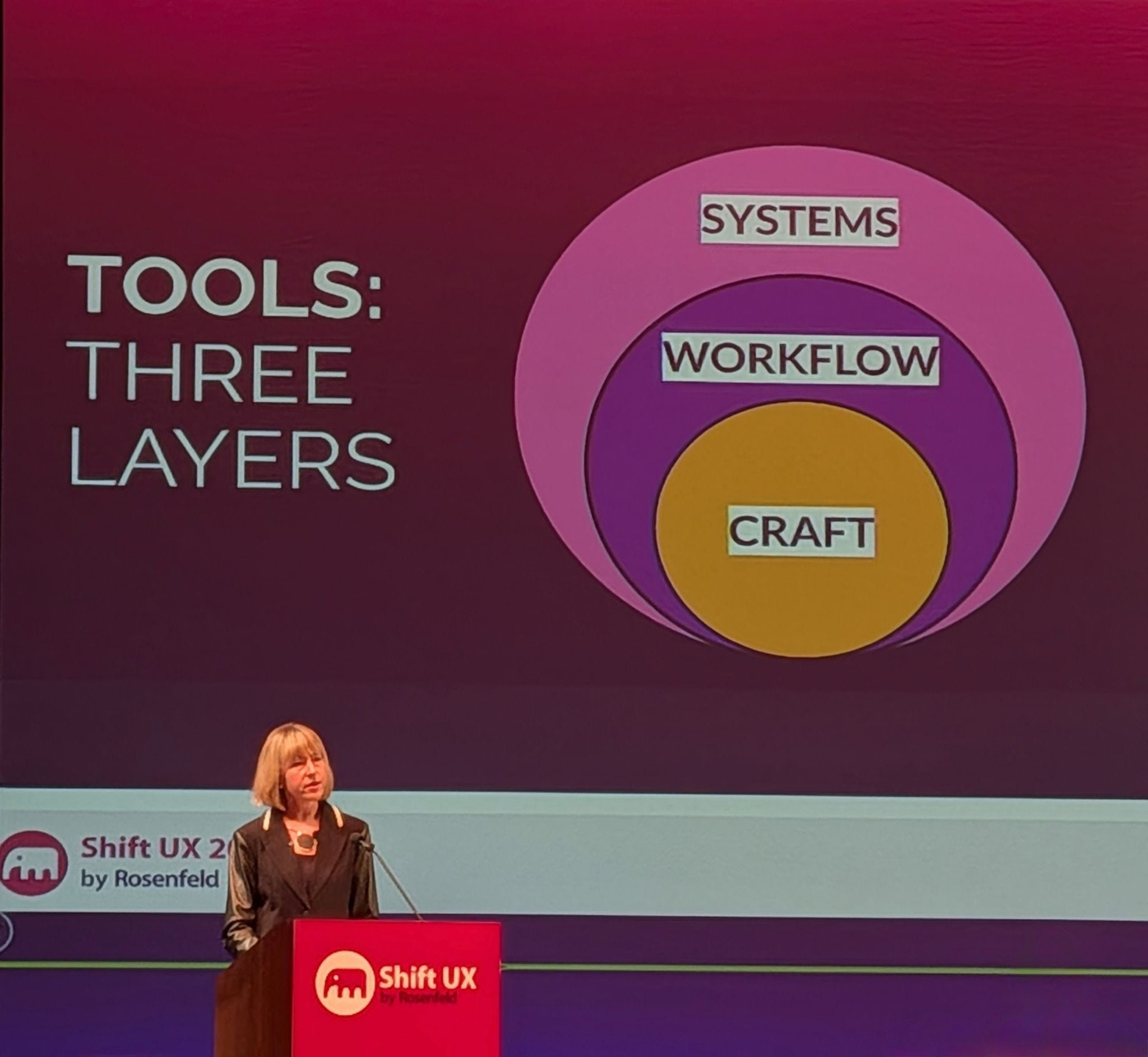
🤔 Wait, what’s Shift UX? It was a two-day conference held by Rosenfeld Media (also my book publisher) in Brooklyn last week. The event brought UX practitioners together to help make sense of the rapid shifts happening across our industry and engage in conversations to shape its future.
I co-curated the program alongside Jem Ahmed (Strategic Research track), Jon Fukuda (From Operations to Orchestration track), and Abby Covert (sensemaker extraordinaire and MC), and of course, Lou Rosenfeld.
One week out and many conversations later, these are the five messages from Shift UX that have stuck with me:
1. Keep calm and float on.
From keynote opener Catt Small to keynote closer Jesse James Garrett, there was a common, reassuring message from seasoned practitioners who have seen some shifts (see what I did there?) Specifically: the current industry turbulence is a natural evolution of our craft and has priors that we can learn from.
Catt challenged the prevailing “we’re cooked” narrative.
Drawing on her 16 years of design experience, Catt pointed out that UX has repeatedly rebranded its titles, from web designer to UI/UX designer (shudder) to product designer, and swapped its software from Sketch and Zeplin (hey, that’s when I started!) to Figma. Now, in her words, “the recipe is changing again”.
In his conversation with Abby, Jesse revisited his famous 2009 Memphis Plenary speech, where he declared that “There are no information architects. There are no interaction designers. There are only, and only ever have been, user experience designers.”
Just as holding onto rigid artifacts left specialists vulnerable then, tying one’s identity to screen production or specific software leaves practitioners exposed to today’s AI transition. When asked how practitioners can get out of their own way today, Jesse said: “I think letting that identity float and allowing it to become something else is a piece of it”, decoupling our worth from outputs to remain adaptable.
“Let that identity float and allow it to become something else.”—Jesse James Garrett
2. Insight is not knowledge.
Modern organizations face an unprecedented surplus of information (if you’ve ever stared down a glut of AI-generated documentation sent to you by an excited stakeholder, you know what I’m talking about).
Jem made the important distinction between insights and knowledge: “Insight is a partial truth”.
Automated systems quickly generate isolated “insights”, but these fragments often contradict one another or shift across context.
“Insight is a partial truth, and partial truths are tricky things”. —Jem Ahmed
Turning disparate insights into strategic direction requires both a deliberate approach to sensemaking and good organizational health.
Per Jem, organizations must learn to “metabolize knowledge” through structured stages of ingestion, digestion, circulation, assimilation, and use. Progress relies on (human) facilitators who evaluate evidence, reconciling conflicting findings to guide high-stakes decision making.
3. Design cellos, not kettles.
Dan Saffer, one of the speakers in my human-centered tooling track, explored how generative AI tools reshape human capabilities using three metaphors: kettles, cameras, and cellos.
A kettle is a simple, “low-floor/low-ceiling” tool. You don’t improve at boiling water over time (nor should you).
Fun fact: The floor/ceiling language channels Changying (Z) Zheng’s stellar talk, What the Floor Buys the Ceiling, about how integrating AI into workflows raises the execution floor, buying teams time to shift focus away from pixel tweaking and toward high-stakes product decisions. Z spoke after Dan in my track, representing the “workflow” layer of Three Layers of Designing Human-Centered Tooling.
Most of our current AI tools operate like kettles, taking over both execution and judgment, leading to cognitive offloading and deskilling.
A camera sits in the middle as a “low-floor/high-ceiling” tool. While auto-exposure automated technical operating skills, the human skill of “seeing”, such as composition and knowing what’s worth capturing, became the scarce resource.
A cello represents a “high-floor/high-ceiling” instrument of craft. It requires practice, and introduces productive friction to build mastery over time.
As a way to preserve human judgment and prevent enkettlefication, Dan advocated for integrating decision logs directly into AI systems. Drawing on concepts from David Hoang’s article, The Ledger of Design, Dan emphasized the importance of maintaining a “thinking trail” alongside automated outputs to record what choices were made and why.
“When the outputs are cheap, it’s the thinking trail that becomes really important.”—Dan Saffer
4. Play jazz together.
When jazz musicians perform together, they share a foundational understanding of musical structures while adapting in real time across instruments (aka improvisation).
That collective harmony is what Jon called on as a metaphor to describe the necessary UX shift from operations to orchestration.
Without that shared foundation, cross-functional partners act on isolated, conflicting signals.
Dr. Jamika Burge in Jon’s track illustrated this point with a case study in which data science saw low usage of a feature; engineering suspected an instrumentation bug; research uncovered discovery flaws; and product management canceled the feature altogether.
“Nobody had the whole picture until four of these disciplines came together in the same room before the roadmap actually shipped.”—Jamika Burge
Orchestration breaks down these departmental silos so teams can evaluate the full picture together.
This shift requires moving from departmental ownership to shared accountability across functions. One way to do this is establishing agreed-upon success metrics upfront, acting as a “brake on the velocity focus” (Jamika’s words) before production momentum takes over.
5. (Psychological) safety first.
Navigating the unknown requires a willingness to experiment and openly learn from the results.
Or, in Jesse’s words: “I think we need to be more comfortable making s*$# up and then being wrong.”
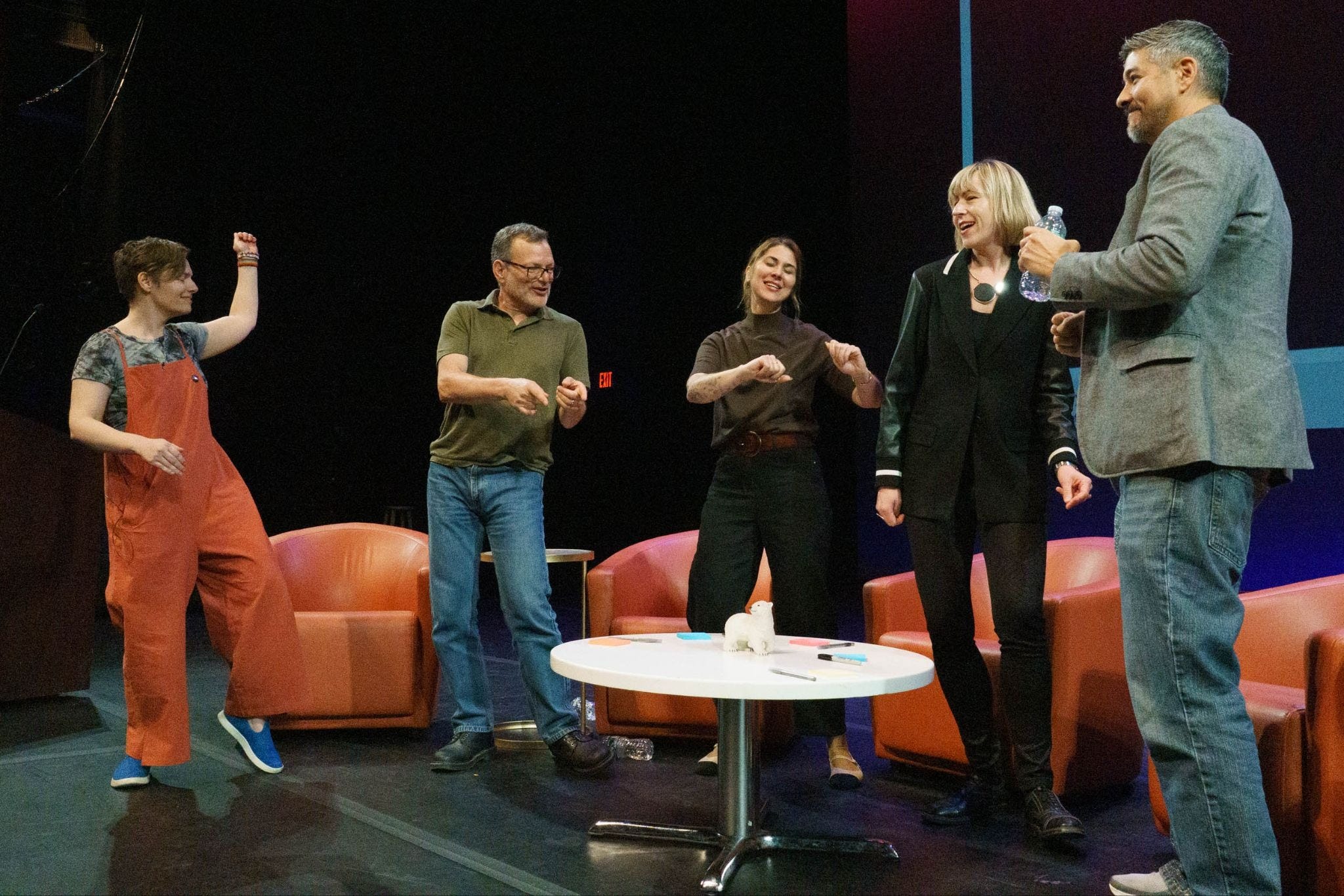
Us curators aimed to model this in the conference structure itself. For example, Abby introduced the concept of live sensemakers: people whiteboarding (IRL or digitally) on stage as speakers were presenting, and then leading speakers and the audience in a collective sensemaking session. To my knowledge, this is the first time this model was applied in a conference setting.
Some of it worked really well. Some of it didn’t land.
And that’s ok.
On day two of the conference, the sensemaking team gathered on stage to openly critique their process, evaluating what worked and acknowledging what fell short.
In every conversation I had with attendees, folks praised this process. Modeling failure and real-time iteration was refreshing, even cathartic.
It reminded me of the same intentional experimentation required when learning the strengths and edges of AI tool capabilities, in order to wield them effectively.
Importantly, there’s a reason experimentation worked at Shift UX: our curation team and leadership (Lou) were off the charts with psychological safety.
As I recently spoke about on Jesse and Peter Merholz’s Finding Our Way podcast episode, people aren’t going to ‘pull the andon cord’ if psychological safety isn’t in place.
🤔 Wait, what’s an andon cord? The Toyota Production System (TPS) would transform Toyota into a global leader in the auto industry, improving efficiency and quality (what a thought!). The TPS principle of jidoka, automation with a human touch, was key to this success. One of its most famous implementations was the andon cord.
Each worker could pull the cord (or later, press a button) to stop the line if they noticed an issue, such as a defect or safety hazard. This process empowered front-line workers to halt production, immediately addressing issues that would otherwise degrade quality.
Imagine being the person pulling the cord and the conditions that need to be in place for that to feel not just ok, but a core responsibility of your role.
Leaders are in a unique position to model the courage to fail and learn out in the open.
“Your job as a leader is to make sure that whatever decision is made, every person—in whatever boat they find themselves in during this storm—is enabled, and that you give them the cloud cover to do it.”—Jem Ahmed
Closing Remarks
My exit from the conference was swift on Friday afternoon, running in my not-running-shoe Fluevogs to catch my flight ahead of the incoming nor’easter (good timing too, it literally started raining while on the runway).
First, though, I shared closing remarks onstage alongside my fellow curators and Lou.
Despite the very real state of layoffs and headline doom, I said we’re headed into a golden age of UX.
Wait, what?
If you know me, you know I love a good Fitts’ List: two columns listing unique human and machine strengths, respectively. I’m bullish that problem (re)framing and Knowing Context (in a deep ethnographic sense) will remain in the “human” column.
That context part is especially important for what’s coming after agents on our screen.
Physical AI is building out machines’ perceptual capabilities; they’ll be able to do more things in the world. Contextually aware interaction patterns are non-negotiable to designing physical AI products that are useful and usable.
Domestic robot Nome by Frog is a nice example; check out my interview with Binna Lee for more.
My final point was about the importance of radical interdisciplinary collaboration to approach wicked problems. Think: Governance of increasingly autonomous systems or saving social media from itself.
Shout out to my track speaker, UX leader and author Sheryl Cababa, for the social media case study and sharing systems thinking frameworks with the Shift audience. Her talk was the “systems” layer of Three Layers of Designing Human-Centered Tooling.
This looks like ethnographers working with ML engineers. UX designers working with policy makers and economists.
Forget the soloists. I’m ready for the jazz fusion era of UX.
💬 Attended Shift UX? What ideas stuck with you? Let me know in the comments.
⏪ Recent Episodes
ep. 102. Shaping the Tools that Shape Us
ep. 101. AI Knows the Average. Except, Your Users Aren’t Average.
ep. 100. The Newsletter Provides: Reflections, 100 Episodes and One Book Later
🚀 Sendfull in the Wild
What Your Machines Should Do: Preorder Now
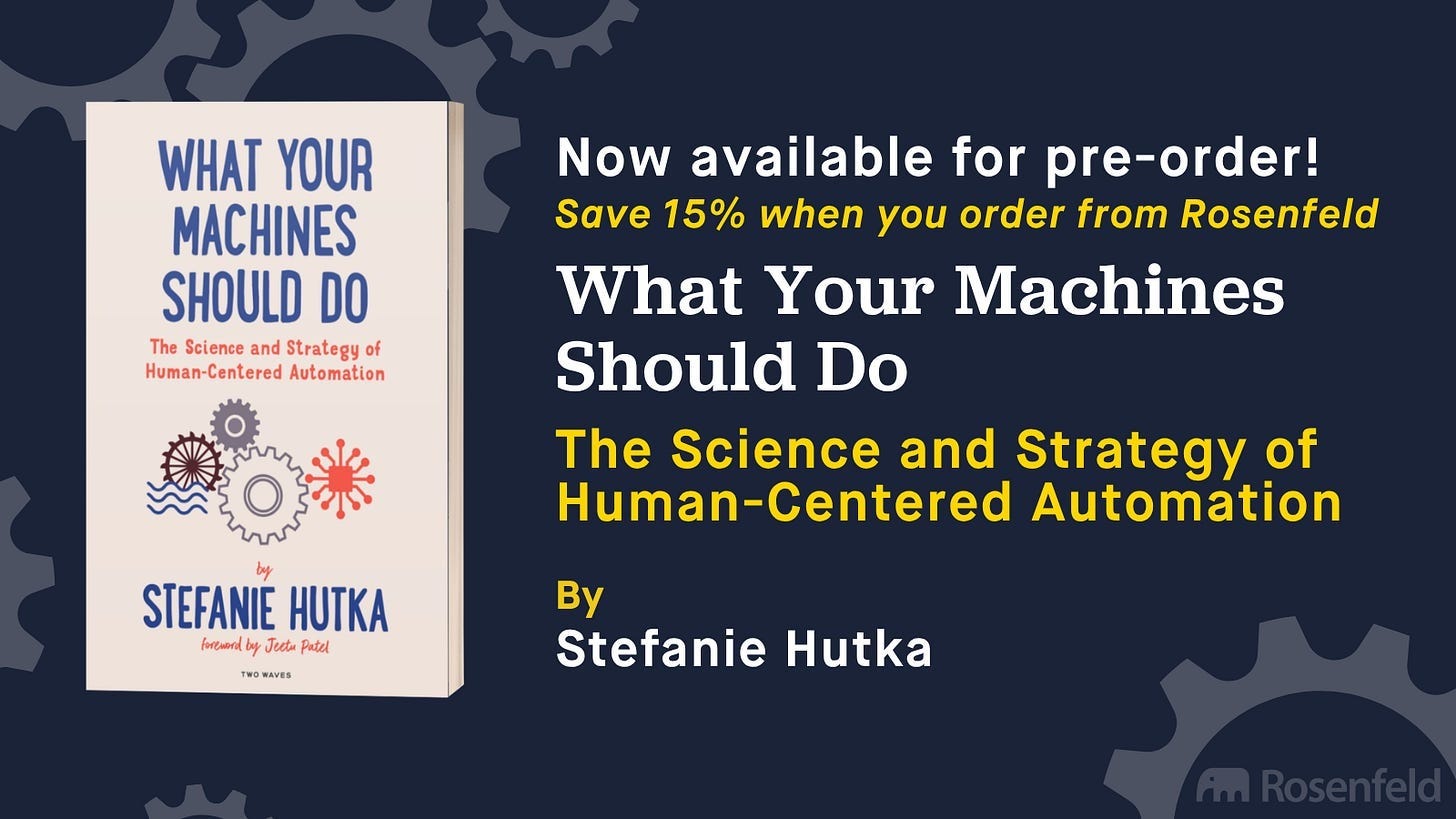
What Your Machines Should Do is a field guide for design and product decision-makers navigating AI automation, helping you steer technology to extend human capabilities and drive business results. That means closing the Automation Strategy Gap, where aspirations of fully automated futures become disconnected from organizational readiness and customer value.
You’ll gain frameworks and tools to set deliberate direction (where your organization is going and why), directed progression (how to sequence automation rollout to get there), and grounded tactics (day-to-day decisions about how to automate).
Upcoming Book Talks
UC Berkeley: Design Field Notes (Berkeley), November 3.
DesignMeets & OCAD U (Toronto), November 26.
Service Design Book Club, (Remote), December 2.
UC Berkeley: School of Information (Berkeley), December 2.
🎉 Pre-order What Your Machines Should Do today for 15% off.
EPIC 2026 Conference (Chicago)
This year’s EPIC Conference theme is Context: How do we model, predict, and interpret it to create value for people and business?
Myself and co-chair Todd Palmer will lead an immersive, hands-on learning day before the main conference, Building with Context: How to Translate Human-Centered Insights into Working Prototypes with Vibe Coding (sold out! Twice!)
👉🏼 Read more about how we’ve been putting together Building with Context in this interview.
📖 Good Reads
Don’t be fooled by this summer of AI hype: Timnit Gebru and Emily Bender (yes, of The Stochastic Parrots paper) argue that terms like “rogue model” and “superintelligence” assign agency to products, shielding the companies that build them from accountability.
What work can robots do?: Anthropic researchers estimate that robots can already perform 74% of physical job tasks in the US, mostly in purpose-built settings, yet cost less than human labor for only 0.3% of all work.
The ledger of design: The David Hoang article that Dan referenced at Shift UX, which argues that because AI makes finished-looking work cheap, credibility now depends on a visible record of how the work was made.
That’s a wrap 🌯 . More on UX and automation from Sendfull in two weeks!