
Automation in the Field: A Conversation with Konstantinos “Kostas” Kandylas
A Preview into Designing Automated Futures

One of my favorite parts of writing Designing Automated Futures is having conversations with technology leaders tackling the question, “How do we automate?” I recently had the opportunity to sit down with Konstantinos “Kostas” Kandylas, CEO of Terra Robotics, headquartered in Thessaloniki, Greece.
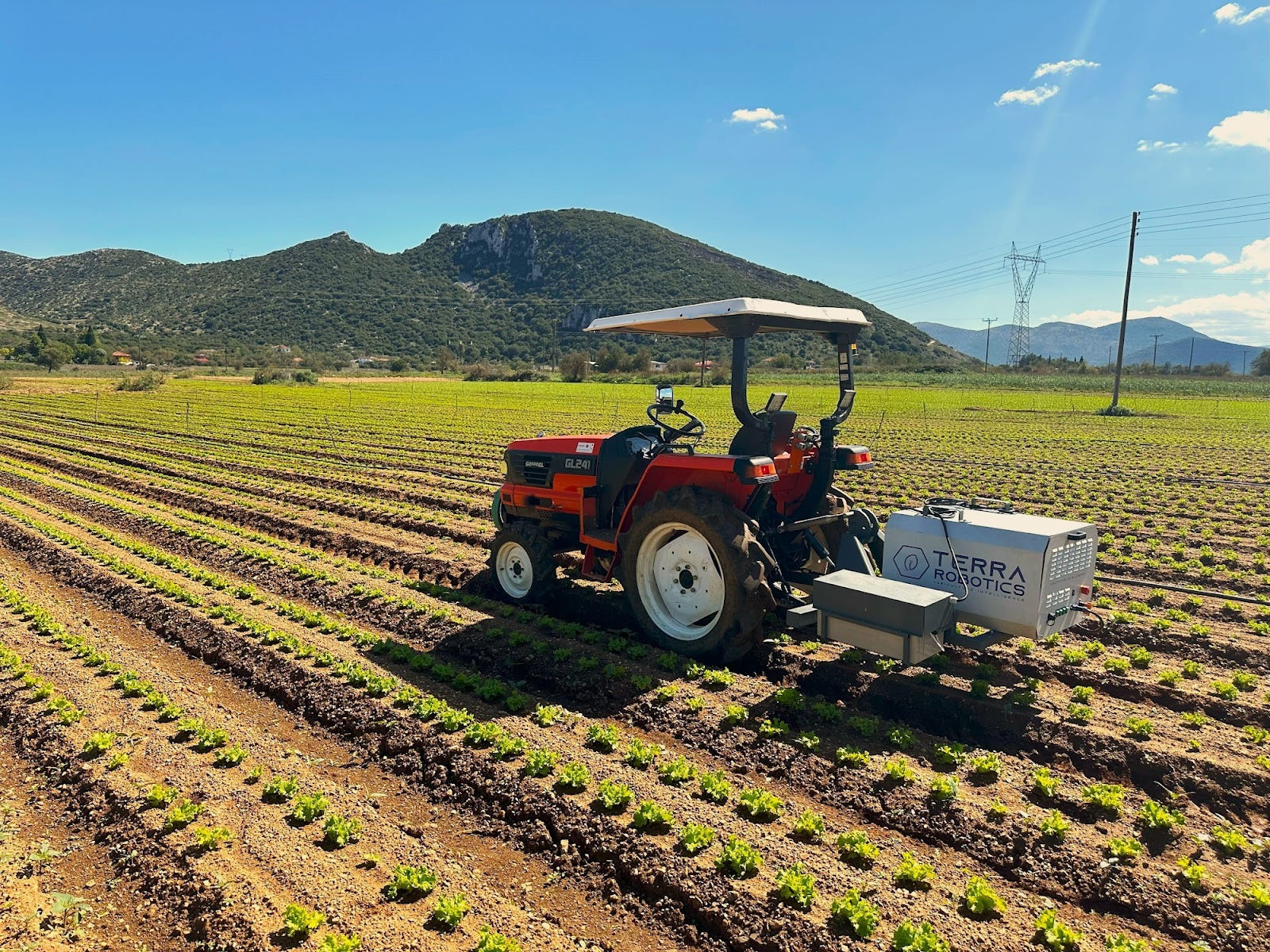
Kostas’s team built the Laser Weeder—an AI-powered weeding solution that identifies and eliminates weeds with lasers, rather than herbicides. Their vision? Bring sustainable, accessible, and scalable farming to life. Terra Robotics recently raised €1.8 million to accelerate the commercialization of their laser weeding technology.
Today’s episode shares insights from my conversation with Kostas about the story behind the Laser Weeder and how his team approaches automation, while keeping farmers front and center.
This interview has been edited for length and clarity.
In Conversation
What’s the origin story of the Laser Weeder?
Kostas: I’m an engineer, farmer and co-founder at Terra Robotics. My farming background comes from my family. We have an agriculture business, growing medicinal plants and exporting them. In parallel with studying engineering at the Aristotle University of Thessaloniki, I was working with my father in the fields.
I faced a problem every weekend: Weeding. Because we had an organic crop, we couldn’t use herbicides. Mainly, people are workers in the field, working inside the crop and removing the weeds by hand. We couldn’t find workers when we needed them the most. Weeding is time-sensitive, it needs to be done in a specific time window, because weeds can progress 10x faster than the crop itself.
I met Petros Katsileros, now a co-founder at Terra Robotics, at university. We were both part of university teams building robotics, and started building a robot that could help with the weeding problem. We later had Ioannis Bakatsis, an agronomist and economist, join as third co-founder, rounding out the team’s core expertise.
What did you automate first?
Kostas: We started building an autonomous robot. The idea was that after solving autonomous navigation (automating the role of the tractor driver), we would then add weeding capabilities. We got to a point where we could navigate semi-autonomously, and started getting feedback from our first potential customer. He liked it, but what he really wanted was the weeding tool.
This was a signal—he doesn’t actually need an autonomous robot, he needs a weeder. So we pivoted. With the autonomous robot, you’re replacing a driver. With the Laser Weeder, you’re replacing 10 or more people doing the weeding, and that was the biggest pain point. In 2023, we raised our first round, and started developing the Terra Weeder.
How does the Laser Weeder work today?
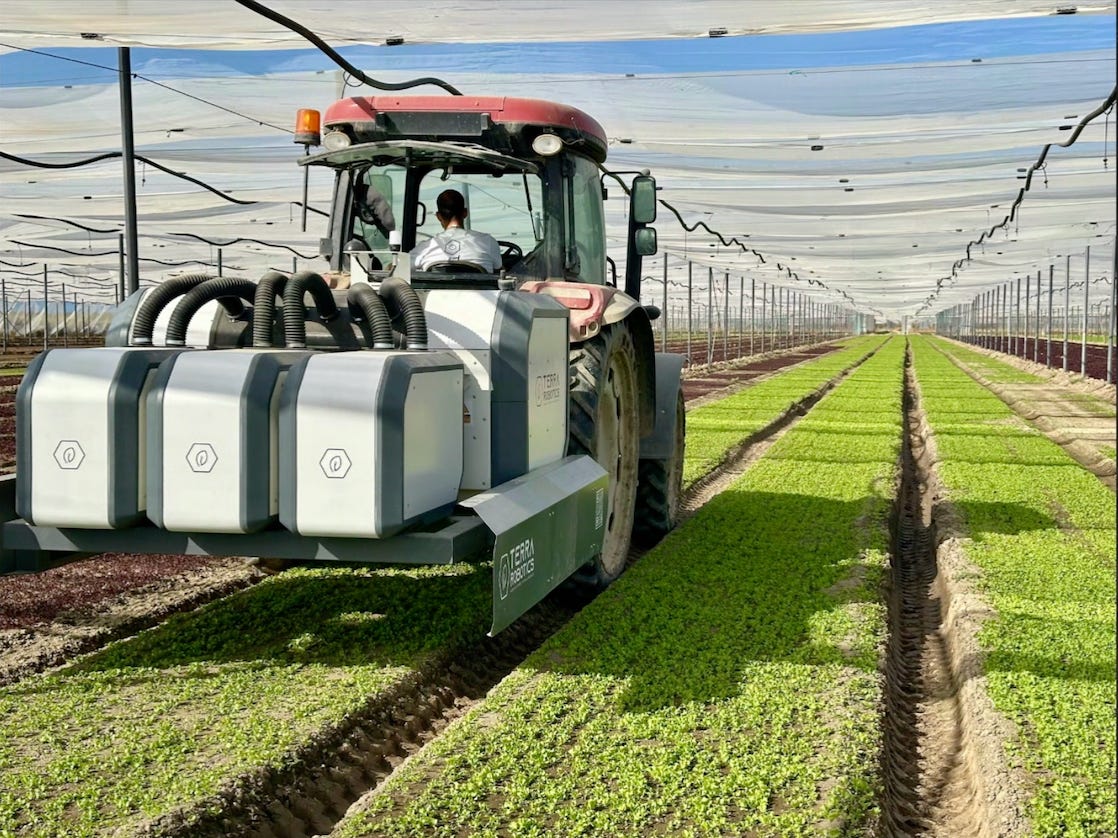
Kostas: It’s equipment you attach to a tractor. As you drive across the crop, it scans the field, and using AI, maps what are weeds versus crops. After one week of training, the Laser Weeder can start weeding in a new crop.
We knew that farmers need a solution that is flexible and modular—it needs to be easy to swap out. We also wanted to build a tool that’s accessible—something that can fit in all farms. Because of that, the Laser Weeder’s form factor is a box you can easily add or subtract.
We optimize for detecting weeds, not crops. If you have even a small false negative rate with crops, you end up killing a lot of plants. By focusing on weed detection, we now detect less than 0.1% of crops.
How do you make decisions about what to automate?
Kostas: How easy it is to build, and customer impact. “Not easy” means we need 6 months with four people developing it.
For impact: because we collect tons of data when we scan fields, we could create many software features from this data. For example, counting how many plants there are. A farmer might be surprised in a good way by these features, but they’re not directly solving problems. They’re fancy, but add-ons—not core to the main product.
How do you define success?
Kostas: The farmer defines success. There are two aspects. The first is the actual result in the field. You start with 100 weeds per square meter. After passing over the field once with the Laser Weeder, the number drops to 20 or 10 weeds—that’s success to the farmer. It translates to fewer workers in the field, fewer hours, lower costs.
The other aspect is that by using our technology, we lower herbicide use. That creates value for the farmer because they can sell their harvest at a higher price.
With the same tool, we lower the cost but also increase the farmer’s revenue.
This second aspect is more difficult to show. You need at least a half season to show ROI. We try to show the farmer that the laser weeder not only tackles your problem now, but creates a different potential value in the future.
AI is a core part of the Terra Weeder. Do you think AI is overhyped or underhyped?
Kostas: It’s overhyped because VCs invest money in AI, but it’s not applied to areas where it has real impact. AI can solve minor daily problems like scheduling or your optimized training run distance—that’s good. But there are many significant problems that impact our lives where AI could be applied, like in biomedical or agriculture sectors. Investors tend to focus on the minor daily problems. We just raised about 2 million Euros, and it was hard.
What do you think people misunderstand most about automation in the agriculture sector?
Kostas: We work with farmers. One thing that is misunderstood is that you can apply cutting edge technology overnight. Farmers don’t have much exposure to deep tech development, and want it to work perfectly and fast from day one. It’s not traditional equipment, so it can’t work like traditional equipment. When you previously needed a mechanic to service your equipment, you now might need an engineering PhD to come onsite.
Three Takeaways
Most conversations these days tend to focus on software-based cognitive automation—particularly, agentic workflows. It was refreshing to speak with Kostas, learning about his experiences building physical automation for agriculture. It was tough to narrow it down to just three takeaways from our conversation, but here they are:
1. Automate the Bottleneck, Not the Process
Map the customer’s end-to-end workflow. Identify where the bottlenecks are and target those first with automation. Kostas’s team began by automating navigation but pivoted to weeding once they realized replacing drivers wasn’t the farmer’s main bottleneck.
2. Focus on Value Creation, Not Just Cost-Cutting
Automation should both reduce cost and create new value, consistent with what BCG observed in the 4% of companies seeing ROI on generative AI. The Laser Weeder cuts labor and herbicide use simultaneously, lowering costs while raising crop value by enabling organic produce.
3. Prioritize by Effort x Customer Impact
When deciding what to automate, Kostas’s team weighs how much effort it takes to build against customer impact. Even when they could easily build any number of new features, they prioritize what delivers the greatest impact for farmer, staying close to their core need.
This episode is a sneak peek into topics from my forthcoming book with Rosenfeld Media, Designing Automated Futures. 🔗 Sign up to be the first to know about new book releases, sales, and events.
🚀 Sendfull in the Wild
Upcoming Events
Product Pulse: Navigating AI and the New Product Landscape
When? October 29
What? I’ll be speaking on a panel about how AI is reshaping product responsibilities, tools, and careers, focusing on prototyping, validation, and design.
Where? Online. Get tickets here.
DesignMeets x Business Design Initiative: AI & Human-Centered Design
When? November 19
What? I’ll be speaking on panel about how human-centered design is evolving in the age of AI.
Where? Rotman School of Management, University of Toronto. Get tickets here.
Still in the Loop: Leading with Human-Centered Design in the Age of AI
When? November 21
What? I’ll be sharing a framework and tools from my forthcoming book, Designing Automated Futures, to help practitioners navigate and thrive in the evolving AI landscape.
Where? In person at the University of Toronto and online. Get tickets (free!) here.
⏪ Recent Episodes
ep. 79: Principle #3: Just because you can automate, doesn’t mean you should.
ep. 78: Principle #2: Technology can automate tasks, not jobs.
ep. 77: Principle #1: Automation is a spectrum
📖 Good Reads
Annual State of AI Report: Air Street’s 313 slides covering AI research, industry, politics, safety, recent survey data from the US, UK, and Europe, and predictions.
Cartography of Generative AI: Estampa, Barcelona-based artist collective, created a conceptual map that captures the many interconnected actors, systems, and resources that make up the evolving ecosystem of Generative AI.
Building in the AI Era: The HeyGen Way: For a while now [1, 2], I’ve been saying generative AI is rewriting the product development playbook. HeyGen, AI-powered video generation platform, has now literally rewritten theirs.
That’s a wrap 🌯 . More on UX, HCI, and strategy from Sendfull in two weeks!